


How Are Microbial Agricultural Inputs Different from Fertilizers/ Pesticides?
Understanding their definition, how they work, and the global market
What Are Microbial Agricultural Inputs?
Microbial agricultural inputs are agricultural products that contain living beneficial microorganisms and are applied to seeds, plants, the rhizosphere, or growing media. Internationally, these products are often classified within the broader category of biostimulants.
Rather than directly supplying nutrients, their role is to support the plant's natural physiological processes , helping plants use nutrients more efficiently, cope with environmental stress, and potentially improve growth, quality, or yield.
One of the most widely referenced international definitions comes from the EU Fertilising Products Regulation EU 2019/1009, which includes plant biostimulants as a defined product category.
Under this framework, a biostimulant stimulates plant nutrition processes independently of the product's nutrient content, with the purpose of improving one or more of the following characteristics:
- Nutrient-use efficiency
- Tolerance to abiotic stress, such as drought, heat, or salinity
- Crop quality traits
- Availability of confined nutrients in the soil or rhizosphere
How Do Microbial Agricultural Inputs Work?
The broader biostimulant category also includes non-living materials such as seaweed extracts, humic and fulvic acids, amino acids, and protein hydrolysates. Microbial products are different because they contain living microorganisms.
Common microorganisms used in agricultural products include nitrogen-fixing bacteria, rhizobia, mycorrhizal fungi, and Bacillus species.
Once established in the rhizosphere, these microorganisms may influence the surrounding environment through processes such as breaking down organic matter, helping release phosphorus and potassium that are bound in the soil, and producing extracellular polysaccharides.
The key difference from plant extracts is that microorganisms are alive, so their performance depends in part on whether they can successfully establish and remain active in the rhizosphere.
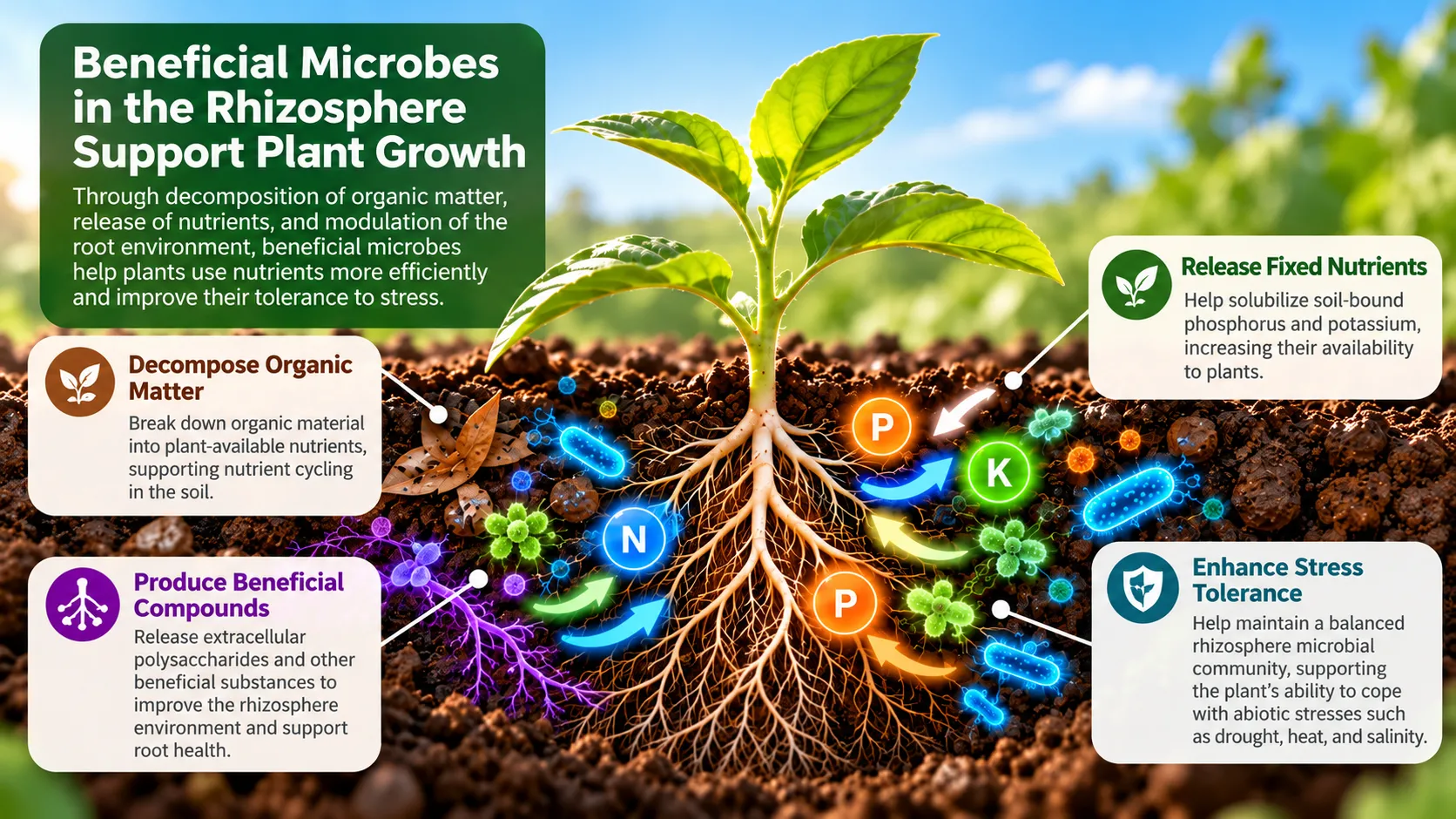 Image caption: Microorganisms can participate in nutrient transformation and environmental regulation in the rhizosphere through multiple biological mechanisms.
How Are Microbial Inputs Different from Fertilizers and Pesticides?
The most fundamental difference is what each type of product is intended to act on.
Fertilizers: Directly provide nutrients required by plants, such as nitrogen, phosphorus, and potassium.
Pesticides: Target harmful organisms such as plant pathogens, insects, or weeds.
Microbial agricultural inputs: Act primarily on the plant and its rhizosphere environment, with the goal of supporting nutrient use and the plant's ability to respond to environmental stress.
In other words, microbial inputs are not intended to replace fertilizer. Their role is to help the plant and root-zone system use applied nutrients more efficiently. They are also not primarily intended for pest or disease control.
When determining which regulatory category a product belongs to, the key factor is often not just what it contains, but what the product claims to do.
The same microbial strain may be classified differently depending on the claim being made. If a product claims to improve nutrient uptake, it may fall under a fertilizer or biostimulant framework. If it claims to suppress pathogens, it may enter the pesticide registration system in many countries. This is one reason why similar microbial products may be labeled and marketed differently from one country to another.
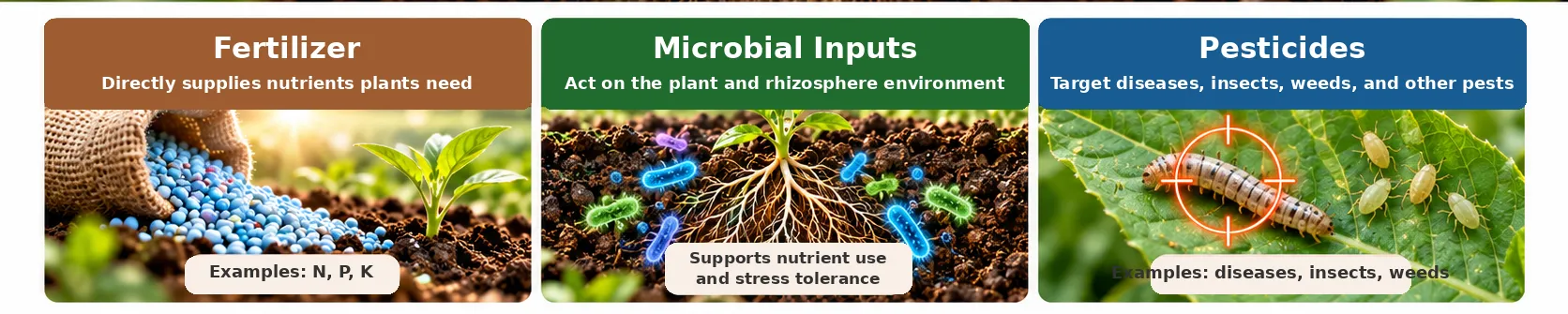 Image caption: Fertilizers supply nutrients, pesticides target harmful organisms, while microbial inputs focus on the plant and the rhizosphere environment.
How Large Is the Global Market?
According to DunhamTrimmer's 2025 industry report, the global biostimulant market, which includes microbial agricultural inputs, is valued at approximately US$4.47 billion. The market is projected to grow at a compound annual growth rate of approximately 9.9% through 2030.
Latin America is one of the largest and fastest-growing regions by value, with Brazil accounting for roughly half of regional revenue. The United States is the largest individual national market.
By crop category, fruits and vegetables account for more than half of market demand, while field crops and cereals are among the fastest-growing segments.
Major drivers of market growth include fertilizer price volatility, policies aimed at reducing chemical inputs, increasing pressure from extreme climate conditions, and growing demand for more sustainable agricultural production from both supply chains and consumers.
 Image caption: The global biostimulant market continues to expand, with Latin America and the United States representing important markets.
How Should a Microbial Agricultural Input Be Evaluated?
Microbial products are not a universal solution. Their performance can be affected by crop type, soil conditions, climate, and application method. In most cases, their role is to improve efficiency within an existing management system rather than independently produce dramatic yield increases.
When evaluating a microbial product, start with three questions:
1. What is its proposed mode of action, and is it supported by published research or field trials?
2. Did the trials include a control group, and were the trial conditions similar to your own field or greenhouse environment?
3. How is the product registered in your local market, and are its claims consistent with that regulatory category?
A well-developed microbial product should be able to clearly explain how it works, the conditions in which it is best used, and its practical limitations.
Sources: Regulation (EU) 2019/1009|DunhamTrimmer, 2025 Global Biostimulant Market Report (cited by AgFunder News, Nov. 25, 2025)
```
Related articles
NOTICE
Microbes Aren't Fertilizer—So What Do They Actually Do in the Soil?
From the rhizosphere and nutrient cycling to everyday crop management, here’s how agricultural microbial products fit into a modern growing system.
NOTICE
Disease Is the Outcome, Not the Cause
Reading root-zone stress in Phalaenopsis through EC, and why sphagnum makes it so hard to manage

NOTICE
The Day They Leave the Flask: Who Claims the Root Zone First?
How the rhizosphere microbiome begins to form as Phalaenopsis seedlings are deflasked and acclimatized